
Table of Contents
1. Understanding Industrial Material Dryer
2. Main Types of Industrial Drying Equipment
3. Performance and Energy Efficiency Comparison
4. Compatible Industrial Materials for Drying Processing
5. Core Industrial Application Scenarios
6. Basic Operation and Maintenance Tips
7. Industry FAQs for Industrial Material Dryer
1. Understanding Industrial Material Dryer
Industrial material dryer is professional processing equipment. It remove moisture from bulk industrial materials through controlled heat and airflow.
It different from civilian drying machines. It handle high-volume, high-density industrial raw materials and finished products.
Stable moisture control is critical for industrial production. Excess material moisture cause product deterioration, low strength and short service life.
Standard industrial drying systems include heating unit, airflow control module, drying chamber and exhaust device. All parts work steady for continuous production.
2. Main Types of Industrial Drying Equipment
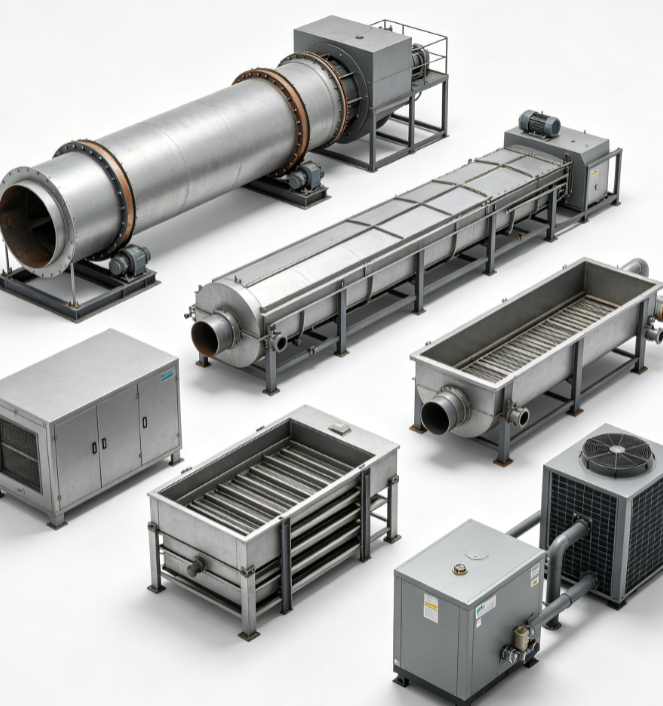
Multiple industrial dryer designs fit different material traits and production demands. Each type has unique working features.
2.1 Rotary Drum Dryer
Rotary drum dryer is the most common heavy-duty industrial material dryer. It use rotating drum structure to tumble bulk materials evenly.
It suit large granular materials like sand, ore and chemical particles. It support long-time continuous running.
2.2 Fluidized Bed Dryer
Fluidized bed dryer blow hot air upward. It suspend materials in airflow to achieve full contact drying.
This equipment deliver uniform drying effect. It widely used for fine powder and small granular industrial materials.
2.3 Hot Air Tray Dryer
Hot air tray dryer adopt static layered drying mode. Materials place on trays inside sealed drying cabinets.
It fit small-batch and high-precision drying tasks. Common for food additives and fine chemical materials.
2.4 Industrial Heat Pump Dryer
Heat pump dryer is energy-saving drying equipment. It recycle waste heat to reduce power consumption.
It work with low and medium temperature settings. It protect heat-sensitive materials from damage.
3. Performance and Energy Efficiency Comparison
Thermal efficiency and energy consumption are core selection indexes. The table below list verified industrial test data for mainstream dryers.
Dryer Type | Thermal Efficiency | Specific Energy Consumption (kJ/kg Water) | Drying Uniformity Error | Best Suitable Material Size |
Rotary Drum Dryer | 40%-55% | 3000-5000 | ±0.5%~±1.5% | 1mm-100mm+ |
Fluidized Bed Dryer | 60%-80% | 2500-4000 | ±0.1%~±0.3% | 0.1mm-8mm |
Hot Air Tray Dryer | 35%-55% | 4500-6000 | ±0.2%~±0.8% | Powder & small blocks |
Heat Pump Dryer | 75%-85% | 2200-3200 | ±0.1%~±0.4% | Heat-sensitive materials |
Fluidized bed and heat pump dryers have obvious energy saving advantages. They reduce long-term operational costs greatly.
Rotary dryer have lower precision. But it support ultra-large throughput. It irreplaceable for heavy industrial raw material processing.
4. Compatible Industrial Materials for Drying Processing
Different industrial material dryer match different material properties. Wrong selection cause material waste or unqualified products.
Mineral materials like sand, ore and quartz stone suit rotary drum drying. They can bear high temperature and tumbling friction.
Chemical powder, fertilizer and granular additives use fluidized bed drying. It ensure no local overheating and uniform moisture content.
Food raw materials, herbal fragments and biological materials adopt heat pump drying. Low temperature keep material activity and quality.
5. Core Industrial Application Scenarios
Industrial material dryer widely serve multiple manufacturing and processing industries.
Mining and building material industry use rotary dryers. It process massive sand and gravel materials for construction production.
Chemical manufacturing rely on fluidized bed dryers. It stabilize moisture content of chemical raw materials for safe storage.
Food and agricultural processing plants install heat pump dryers. It maintain material nutrition and avoid high-temperature deterioration.
Pharmaceutical and fine chemical factories use tray dryers. It meet small-batch, high-standard drying requirements.
6. Basic Operation and Maintenance Tips
Standard operation extend industrial material dryer service life and keep stable efficiency.
Do not overload drying chamber. Overloading lead to uneven drying and increased energy consumption.
Clean internal residue regularly. Accumulated material debris block airflow and reduce thermal efficiency.
Check temperature sensors every month. Inaccurate temperature control damage heat-sensitive industrial materials.
7. Industry FAQs for Industrial Material Dryer
Q1: Which industrial material dryer has the best energy saving performance?
A1: Heat pump dryer top in energy efficiency. Its thermal efficiency reach 75% to 85%, much higher than traditional hot air drying equipment.
Q2: What dryer is best for fine powder industrial materials?
A2: Fluidized bed dryer is the ideal choice. It provides ultra-uniform drying and avoid powder agglomeration during processing.
Q3: Can rotary dryers process heat-sensitive materials?
A3: No. Rotary dryer work under high temperature. It easy cause material decomposition and quality loss for heat-sensitive products.
Q4: What is the main factor affecting drying uniformity?
A4">Airflow stability, material spreading thickness and temperature consistency. All three factors decide final material moisture uniformity.